EMPI Business School

Author name: EMPI

EMPI Business School

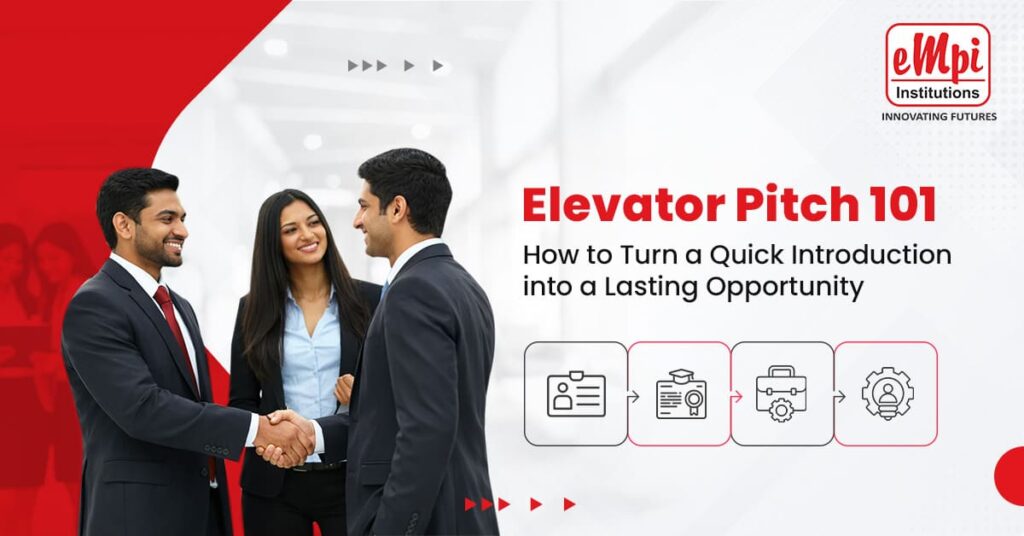
Elevator Pitch 101: How to Turn a Quick Introduction into a Lasting Opportunity

When you’re preparing to present yourself professionally, one tool stands out as your strongest first impression: the Elevator Pitch. It’s your personal headline — a sharp, memorable introduction that captures who you are and what you bring to the table. But what exactly is an elevator pitch? How do you build one? What should it include, how should you deliver it, and what should you avoid? Here’s your quick and handy Cheat Sheet on crafting the perfect Elevator Pitch. WHAT IS AN ELEVATOR PITCH An Elevator Pitch is a brief overview of your professional and educational accomplishments And information relevant to your skills and career goals.  You use it when you introduce yourself to people in networking situations and career fairs  Or answer the interview question, “tell me about yourself.”  It’s also your professional summary on your resume and LinkedIn profile. In essence, an elevator pitch is a 30-60 second “commercial” about you  Your elevator pitch demonstrates your experiences, capabilities and expertise It is an icebreaker that should lead the listener to ask more questions because they want to learn more about you.  How to Write an Elevator Pitch No two elevator pitches are alike since everyone has different backgrounds and experiences to bring to the plate.  While the content varies, they all share similar elements. 1. NAME The person you’re talking to should know your name, especially if you expect them to remember you  2. EDUCATIONAL BACKGROUND: Mentioning the degrees you have will show employers what your qualifications are. Since they are looking for candidates with specific credentials. You can share what you’re studying and when you expect to complete your degree. 3.Professional Experiences Be sure to include your contributions to the professional landscape as well.  If you are coming right out of college with an internship or two with you let employers know you have work experience. 4. Your Value A strong elevator pitch will communicate how you can be beneficial to an organization. You can do this if you review the job description that interests you and determine how your skills and experiences apply to the position. Some of the questions you can ask yourself are: How are you trying to connect with that person? What is the meaning of the relationship that you are trying to establish? Can you help that person? What to Avoid in an Elevator Pitch When done well, your elevator pitch should help you make a positive first impression and stand out to employers.  To do this, you should avoid cliches, jargon and anything too personal. Cliches Avoid using cliche words such as “hardworking” , “well mannered”, “get along well with people”, “have leadership skills” etc. Everyone uses those words. Think a little bit more deeply about what you’re saying to make them (employers) more interested.” Jargon Jargon exists in many industries, but you don’t want to use too much of it in your elevator pitch.  To determine how much you should include, you should consider who you are talking to. Are you talking to a recruiting agency or someone from human resources? If so, exercise limited jargon because they may not share your vocabulary; use just enough to demonstrate your knowledge of the industry. If you’re talking to someone in the same field as you, you can use technical terms. But be sure that you  know the meanings..  Personal Details You should also avoid anything too personal in your pitch. Stay professional, don’t include unnecessary family details or irrelevant hobbies and interests. Other Helpful Elevator Pitch Tips Now that you have an idea of what you should and should not include in your elevator pitch, you’re ready to think about the actual delivery. Make Your Pitch Adaptable The content you include in your pitch and your goals for delivering it should vary by situation.  Your elevator pitch is going to evolve depending on the setting and your purpose for using it. You should also try to tailor your pitch to the employer, when possible, which means it will likely be different every time. Your elevator pitch is an overview of your experiences. So, as you advance in the professional world, so should your elevator pitch. Pay Attention to the Nonverbals Your body language is an essential component of an elevator pitch.  A positive attitude and nonverbal communication will make you look confident and comfortable, which will strengthen your presentation.  “It’s not just what you say; it’s the energy with which you approach anyone. Dress professionally Offer a strong, firm handshake Maintain eye contact, but don’t stare Smile Lead forward slightly Don’t cross your arms Don’t stand too close (or too far away) Don’t smoke beforehand In addition to these tips, make sure you look approachable.  Even if you’re nervous, try your best to relax because your nonverbal communication may convey your emotions without you even realizing it. Mastering your elevator pitch is just the beginning. At EMPI Business School, we transform your communication skills into leadership excellence. Our industry-centric PGDM programs focus on “Individual Grooming” and “Action Learning,” ensuring you are ready to impress in any boardroom. Explore EMPI B School, a top-ranked PGDM institute in Delhi offering cutting-edge PGDM courses. Join one of the best PGDM colleges in Delhi and kickstart your journey with the best PGDM courses in Delhi.

Elevator Pitch 101: How to Turn a Quick Introduction into a Lasting Opportunity Read More »
PGDM Programs at EMPI Business School

Why Are PGDM Programs More Practical Than MBA? 5 Teaching Approaches

When comparing Post Graduate Diploma in Management (PGDM) programs with Master of Business Administration (MBA) programs, it’s clear that PGDM is taking the lead in today’s fast-paced job market. While both programs are designed to hone managerial and leadership skills, PGDM stands out with its hands-on, industry-focused approach. Instead of just theory, PGDM offers real-world exposure, equipping students with practical experience that directly aligns with what employers are looking for.  This unique blend of classroom learning and industry application makes PGDM the preferred choice for aspiring leaders ready to tackle the challenges of the modern business world. We will look at five primary teaching methods that make PGDM programs a more sensible choice than MBA programs.  Approach 1: Industry-Aligned Curriculum One of the primary reasons recruiters favor PGDM graduates is the sheer responsiveness of the curriculum to market changes. Dynamic Adaptation: Because PGDM programs are typically offered by autonomous institutions, they are not slowed down by the bureaucratic delays of large university systems. This allows for the immediate integration of emerging trends like AI and Digital Marketing. Addressing Current Gaps: The curriculum is often designed in collaboration with corporate partners to ensure that what is taught in the classroom mirrors the actual problems managers face today. Cutting-Edge Focus: Programs at EMPI include high-demand fields such as PGDM in Finance, Marketing, HR Management, International Business & Business Analytics with Artificial Intelligence, ensuring graduates are not just updated, but ahead of the curve.   Approach 2: Focus on Real-World Learning The PGDM philosophy moves the classroom into the field, ensuring that students aren’t just reading about business—they are practicing it. Immersion over Observation: While MBA programs often rely heavily on theoretical textbooks, PGDM programs emphasize live projects and rigorous internships. Learning from Real Business Cases: Students dive into complex, real-world scenarios to develop a “complete picture” of organizational growth, struggle, and resolution.2 Critical Problem Solving: By engaging in fieldwork, students sharpen their diagnostic skills, learning how to pivot and solve complex issues under the pressure of real deadlines. Approach 3: Specializations for Career-Relevant Skills Modern organizations are looking for specialists who can master a domain immediately. PGDM programs provide this depth through highly focused concentrations. Diverse Options: Students can specialize in a vast range of sectors including Advertising Communication, International Business (IB), and Finance. Niche Expertise: For example, a PGDM in Business Analytics is specifically engineered for data-driven decision-making, while the Advertising path prepares students for brand management and communication strategies. Global Perspective: The International Business specialization focuses on international trade and cultural exchange, preparing graduates for the global market setting. Outcome-Driven: These specialized paths ensure graduates enter the workforce with specific, in-demand technical skills that set them apart from more generalist MBA candidates.  Approach 4: Corporate-Integrated Learning A PGDM is as much about who you know as it is about what you know. Top-tier institutes like EMPI act as a bridge between the student and the professional elite. Direct Corporate Access: Through strong affiliations with leading companies, programs integrate guest lectures, workshops, and industry tours into the regular schedule. Mentorship Ecosystems: Vibrant alumni networks provide more than just networking; they offer active mentorship and direct paths to high-quality job placements. Insider Insights: These connections offer students an “inside look” at operational realities, helping them build professional connections with industry leaders long before they graduate. Approach 5: Experiential Learning & Live Projects Technical knowledge gets you the interview, but leadership and soft skills get you the promotion. PGDM programs treat these “human” skills as a core science. Experiential Leadership: Through role-plays, leadership workshops, and high-stakes team projects, students learn to navigate interpersonal dynamics and resolve conflicts. Holistic Development: The curriculum explicitly targets emotional intelligence, time management, and strategic decision-making—traits essential for climbing the corporate ladder. Recruiter Preference: Recruiters often prefer PGDM graduates because they possess a refined mix of technical mastery and the interpersonal grace needed to excel in high-pressure professional settings.  Conclusion The evidence is clear that PGDM programs offer a superior practical edge over traditional MBAs. By combining a market-responsive curriculum with intensive real-world exposure, specialized training, and a focus on leadership, these programs prepare students for the complexities of the modern business world. For those seeking to become influential leaders, the PGDM programs at EMPI Business School are the sensible choice for navigating a dynamic global economy. 

Why Are PGDM Programs More Practical Than MBA? 5 Teaching Approaches Read More »

PGDM Programs | EMPI Business School

Why PGDM Programs Are Becoming the Recruiters’ First Choice

Postgraduate Diploma in Management (PGDM) programs have rapidly risen to the top of recruiters’ preferred lists. This shift is driven by the program’s unique ability to blend academic rigor with intensive real-world application—a combination that is essential for navigating today’s volatile and complex business environment. Unlike traditional programs, a PGDM focuses on developing “industry-ready” professionals who can contribute to an organization from day one. Industry-Relevant Curriculum The standout feature of a PGDM program is its inherent agility. Because these programs are typically offered by independent institutes, they are not subject to the rigid, slow-to-change university regulations that often affect traditional MBA programs. This flexibility allows the curriculum to be updated almost in real-time to reflect the latest market disruptions, technological advancements, and global business trends. The focus remains squarely on contemporary relevance. By integrating modern case studies and current market strategies, students don’t just learn historical business theories; they study the live challenges facing companies today. This market-driven approach ensures that graduates are equipped with a toolkit of skills that are immediately applicable to current business problems. Specializations Catering to Diverse Sectors Modern businesses no longer look for generalists; they look for specialists who can master specific domains. PGDM programs meet this demand by offering diverse specializations that allow students to align their education with their specific career aspirations. Whether your interest lies in Finance, Marketing, Advertising Communication, Human Resources Management, International Business or Research & Business Analytics, these programs provide the deep-dive expertise required to stand out. For instance, the rise of big data has made Business Analytics one of the most sought-after specializations. Companies are increasingly reliant on data-driven decision-making, and PGDM graduates who can bridge the gap between complex data and strategic business action are in high demand. These specializations ensure that when a graduate enters the job market, they do so with a profile that perfectly matches the technical requirements of the role. Practical Skills and Real-World Exposure In a high-quality PGDM program, the classroom is only the beginning. The prioritizes “learning by doing,” where theoretical concepts are immediately tested through internships, live industry projects, and corporate field trips. This hands-on experience is what truly sets these graduates apart in the eyes of a recruiter. By working directly with industry leaders and analyzing live market data, students develop a functional understanding of how businesses operate under pressure. For an employer, this reduces the “gestation period”—the time and cost usually spent training a new hire. Recruiters value candidates who can “hit the ground running,” bringing fresh perspectives and practical solutions to the table from day one. Emphasis on Leadership and Soft Skills that Attract Recruiters While technical proficiency is the baseline, it is soft skills that determine long-term management success. PGDM programs place a massive emphasis on developing the “human” side of management: effective communication, critical thinking, emotional intelligence, and collaborative teamwork. Leadership development is woven into the very fabric of the curriculum. Through group simulations and high-stakes presentations, students learn how to lead teams and make critical decisions under pressure. These behavioural traits are often the deciding factor for recruiters looking for future executives who can navigate the complexities of interpersonal dynamics and organizational culture. Rising Demand for Business Analytics The digital transformation of the global economy has fundamentally changed what recruiters look for. There is a surging demand for professionals who are comfortable at the intersection of business and technology. Recognizing this, modern PGDM programs have integrated cutting-edge fields like Artificial Intelligence (AI), Machine Learning (ML), and Data Science into their core business modules. This evolution ensures that graduates are not just traditional managers, but tech-savvy strategists. They are trained to use AI for strategic forecasting and data analytics for business insight innovation. As the job market continues to shift toward a tech-heavy landscape, candidates who possess both a firm grasp of business principles and the technical skill set to solve complex issues will continue to be the most prized assets. Conclusion PGDM programs have successfully established themselves as the premier pipeline for corporate talent. By offering a holistic blend of updated theoretical knowledge, practical industry exposure, and essential leadership coaching, they produce graduates who are ready to lead in a dynamic world. As organizations continue to prioritize technological fluency and adaptability, the PGDM will remain the gold standard for shaping the visionary leaders of tomorrow. For those aiming for accelerated career growth, EMPI, an elite PGDM Institute in Delhi, provides an industry-vetted curriculum designed to ensure your success in today’s competitive global environment.  

Why PGDM Programs Are Becoming the Recruiters’ First Choice Read More »

AI uses in Marketing | EMPI

Why Modern Managers Need AI Literacy: A Complete Guide for PGDM Students

AI literacy is the ability to understand how AI works, how it supports decisions, and how it can be used responsibly within an organization. It does not require coding. It focuses on understanding concepts, interpreting AI outputs, and making informed decisions using technology. Modern managers work in environments driven by data, automation, and digital tools. AI now influences marketing, finance, HR, operations, and customer experience. Without basic AI literacy, managers may find it difficult to make smart decisions or lead teams effectively. AI literacy is no longer optional. It is a core leadership skill. PGDM students who understand AI early will be better prepared for future job roles, team leadership, and strategic planning. This skill will set them apart in a competitive job market. Business impact AI helps businesses work faster and smarter. It reduces manual tasks and provides insights that humans may not see easily. Managers can make quick decisions because AI tools analyse data instantly. AI improves accuracy by identifying trends and patterns across large datasets. This supports better financial planning, market forecasting, and risk assessment. AI-driven companies also gain a strong competitive advantage. They adapt faster, manage resources better, and improve customer experience. Managers who understand AI can use it to build leaner, more efficient processes. They can also innovate faster and create more value for their organization. Core AI concepts managers should know Managers do not need to build AI systems, but they must understand the basics. The first concept is models. These are systems that learn patterns and make predictions. Next is data. AI depends heavily on clean and structured data. Managers must know how data is collected, stored, and used. A pipeline is the workflow that moves data from raw form to the final AI prediction. It includes cleaning, training, validation, and deployment. Finally, evaluation helps check how well the AI works. Managers must understand accuracy metrics, bias issues, and reliability checks. This helps them ask the right questions and make better decisions. These core concepts act as the foundation of AI literacy. They help managers work confidently with data teams and technology partners. Strategy & use cases AI has many practical applications that managers should understand. Forecasting helps predict market trends, sales demand, and financial performance. This allows teams to plan resources better. Automation reduces repetitive tasks in HR, finance, and operations. It frees employees to focus on strategic work. Personalization helps create tailored customer experiences. This improves engagement and increases brand loyalty. Risk detection identifies fraud, errors, or unusual patterns. It helps managers prevent issues before they grow. These use cases show how AI transforms everyday business tasks. Managers who understand them can design smarter processes and lead teams with confidence. Data governance basics Data governance is essential in AI-led organizations. Managers must ensure data quality. Poor data leads to poor decisions. Clean, consistent, and complete data improves AI accuracy. Privacy is another key element. Managers must follow data protection laws and use customer information responsibly.  Compliance frameworks help organizations stay safe and avoid penalties. Ethical guardrails ensure AI is used fairly. Managers should avoid bias, ensure transparency, and make decisions that respect user rights. Ethical AI builds trust and supports long-term success. Even basic knowledge of data governance helps managers make safe, informed, and responsible choices. People management changes AI changes how teams work. Managers must rethink roles, train employees, and support continuous learning. Reskilling programs help employees adopt AI tools and stay productive. Role redesign is also important. Some tasks may shift from manual to automated. Managers must guide teams through this transition. Cross-functional collaboration becomes essential. AI projects involve marketing, IT, analytics, and operations. Managers must communicate clearly and lead teams that work across departments. These people-focused changes require emotional intelligence, leadership, and adaptability. AI-literate managers will be better equipped to drive these shifts. Measuring value AI projects must deliver measurable value. Managers should define the right KPIs for their initiatives. These may include time savings, cost reduction, revenue growth, or service improvement. ROI frameworks help evaluate the impact of AI investments. They guide decision-making and resource allocation. Experiment-driven roadmaps allow teams to test ideas in small steps. Managers can run pilots, gather data, and scale projects that show strong results. This approach reduces risk and builds long-term value. AI literacy helps managers track performance with clarity and avoid wasting resources on projects that do not deliver value. Tools & vendor selection Choosing the right tools is a key managerial responsibility. Managers should evaluate platforms based on ease of use, integration with existing systems, security, and scalability. They must also consider vendor support. Good vendors provide training, documentation, and technical help. This reduces downtime and improves team adoption. Integration is crucial. AI tools must work smoothly with CRM systems, HR platforms, finance software, and other core tools. Managers must ensure compatibility before implementation. This structured approach helps managers choose solutions that improve business performance and reduce long-term costs. Learning path AI literacy is a skill which is developed over small consistent steps. We see short online courses and workshops as great tools for getting in the basic concepts. Also hands-on projects which are practical in nature put that knowledge into play and in turn build confidence. PGDM students will work with small AI enabled case studies, analyze data sets, or test marketing automation tools. These practical tasks which in turn will enhance understanding. Mentorship is also very beneficial. We see value in what the industry professionals and academic staff have to offer which in turn speeds up progress. Also students should seek out that advice and get involved in discussion around AI, analytics, and business strategy. This continuous learning track is for which will take over as managers in a world that is run by AI. Explore PGDM programs at EMPI B School in Delhi. We have the best PGDM courses in Delhi and across India which are designed to prepare you for a successful career in today’s competitive environment. Practical pitfalls AI can deliver great results, but

Why Modern Managers Need AI Literacy: A Complete Guide for PGDM Students Read More »

Use of AI in Marketing | EMPI

How AI Is Transforming Marketing Careers: What PGDM Students Should Prepare For

Artificial Intelligence has become the core of what we see in marketing today. Companies are using AI to better understand their customers in real time, to predict trends before they happen, and to develop very targeted campaigns. This is a massive shift. It is transforming how businesses function, how teams are run, and which skills marketing professionals need to acquire. Marketing is no longer about only creativity and intuition. Data, automation, and machine learning shape every decision. Companies want professionals who understand technology and can use AI tools effectively. This is the reason PGDM students must prepare early. The future of marketing is in the hands of those who can balance between creativity and analytics. How AI reshapes core marketing AI has indeed transformed all aspects of marketing. In the past marketers turned to guesswork and slow data analysis. Now AI does it in seconds. AI improves targeting by looking at user behavior, preference, and browsing trends. It also does an excellent job at segmenting audiences. This in turn means each campaign reaches the right person at the right time. In the space of content creation AI tools support what marketers do at every turn from idea generation to copy write via design to campaign performance. Also they may report to have reduced the manual labor and increased speed of production. AI has become a core element in digital marketing. It improves efficiency, accuracy, and performance. For PGDM students it is important to study these areas as they form the base of what today’s marketing field is about. Technical foundation to build In the field of AI driven marketing growth is seen through the development of strong technical bases. We see which of the basics in analytics, data modeling and measurement frameworks which are very key. Also, although some may not aim to become data specialists, it is still very important that they have a grasp of how data works. A single go at topics like data cleaning, pattern recognition, dashboards and forecasting will have the student making better decisions. Also they should play around with tools such as spreadsheets, visualization tools and basic API based platforms. This is very important for students in the PGDM in business analytics as it is in these courses that they are introduced to the base of what is required for AI driven marketing roles. Creative and strategic skills Even today as we see growth in automation, creativity is still of great value. AI may put out great ideas but it can’t replace human story tellers. Marketers must study up on what makes the consumer tick, brand identity, and long term strategy. Students should work on their creative thinking, campaign planning, and storytelling. Also it is at play in the area of design which is around very effective marketing strategies. What we see is that these skills are very much in demand for students in PGDM in general management which is that they do have to put together insight based leadership with creativity. A great marketer knows the balance between creativity and logic. This mix produces the best campaigns which stand out. People and process angle AI isn’t only a tech shift. Also people and process transformation. Teams have to adopt new tools, improve their skills, and adapt to tech enabled workflows. This transition requires investment in workforce planning and HR support. Companies today are looking for people who have experience in new tools. We see a trend towards continuous learning in the workplace. HR teams are at the fore in creating reskilling programs and AI implementation strategies. In modern marketing we see a great need for coordination between HR, tech, and business units. Students need to be aware of how AI transforms workplace roles, responsibilities, and team structures. Also they must develop adaptability, curiosity, and collaboration skills. That will put them in good stead in AI first organizations. Global opportunities AI has transformed what is possible in marketing. We see companies which were once local now reaching out to multi national audiences via automated solutions. AI in the form of translation, localization and market research tools is what is enabling businesses to break into new markets. Students that want to play in the global field should learn of cultural differences, international consumer behavior, and localization strategies. Also it is useful to study international data guidelines. This is global exposure which adds to the marketing value of students of PGDM in international business’ fields. In the arena of cross border campaigns which is to be taken up by AI we are at the dawn of that future and also we see a great demand for that skilled talent. Practical learning moves  PGDM students’ focus should be on practical learning which in turn will prepare them for AI powered marketing roles. Theory is of less importance as against doing. They should work on live projects, go for internships and get a hand in martech tools. Some helpful steps include: Some actions that prove helpful are:. Testing marketing automation platforms Building dashboards Conducting small scale AI tools research. Working on case studies Learning from live campaigns Even in small scale projects which include analysis of user data or optimization of a digital campaign we see growth in student confidence. Practical experience improves job readiness and also we see that it gives them a better picture of how AI plays out in the real world. Portfolio checklist  A robust portfolio is what will set PGDM students apart in the job market. Presently employers are more into skills which we see in a portfolio rather than a long resume. It is up to the students to put together a portfolio which displays their ability to use AI tools and present insights. A good portfolio may include: A solid portfolio may include:. Campaign case studies Before-and-after comparisons Data-driven improvements Trend analysis Small AI-powered content projects Analytics dashboards Reports with measurable ROI These examples of the student applying what they learned to real world situations which also shows initiative

How AI Is Transforming Marketing Careers: What PGDM Students Should Prepare For Read More »

PGDM in Business Analytics

Top Career Opportunities After PGDM in Business Analytics in India

In today’s data-driven world, businesses rely heavily on insights derived from data to make strategic decisions. This surge in demand for data-savvy professionals has made PGDM in Business Analytics one of the most sought-after courses in India. Students pursuing this specialization gain expertise in analytics, statistical modeling, data mining, and business intelligence, preparing them for a thriving career across industries. If you are considering a PGDM in Business Analytics, it is essential to understand the career opportunities this specialization can unlock. This blog explores the top career paths, industry demand, and skills required for success. 1. Data Analyst One of the most popular career options after a PGDM in Business Analytics is becoming a Data Analyst. Data analysts are responsible for interpreting complex datasets, identifying trends, and generating actionable insights for decision-making. Key Responsibilities: Collecting and organizing raw data Performing statistical analysis using tools like R, Python, and Excel Creating dashboards and visual reports for stakeholders Salary in India: ₹4–8 LPA (entry-level) Industries Hiring: IT, E-commerce, Banking, Healthcare 2. Business Analyst A Business Analyst (BA) bridges the gap between business requirements and technology solutions. With a PGDM in Business Analytics, graduates can analyze business processes, identify opportunities for improvement, and provide data-driven recommendations. Key Responsibilities: Gathering and documenting business requirements Conducting SWOT and feasibility analysis Collaborating with IT and management teams Salary in India: ₹5–10 LPA Industries Hiring: Consulting, Finance, IT Services, Telecom 3. Data Scientist For those inclined toward advanced analytics, Data Scientist is a high-growth career option. Data scientists leverage machine learning, predictive modeling, and big data tools to extract insights and forecast business outcomes. Key Responsibilities: Building predictive models using Python, R, or SAS Analyzing large datasets using Hadoop or Spark Presenting data insights to business leaders Salary in India: ₹8–20 LPA Industries Hiring: IT, E-commerce, Banking, Startups 4. Business Intelligence (BI) Analyst BI Analysts transform data into actionable insights that drive strategic business decisions. With a PGDM in Business Analytics, graduates can use BI tools like Tableau, Power BI, and QlikView to generate reports and dashboards. Key Responsibilities: Monitoring business performance through dashboards Identifying trends and anomalies in data Supporting decision-making with data insights Salary in India: ₹5–12 LPA Industries Hiring: Retail, Banking, Manufacturing, Healthcare 5. Marketing Analyst Businesses rely on data to optimize their marketing strategies, making Marketing Analyst a promising career for PGDM in Business Analytics graduates. They analyze customer behavior, campaign performance, and market trends to enhance ROI. Key Responsibilities: Evaluating marketing campaign effectiveness Segmenting customers and predicting behavior Using analytics tools like Google Analytics, R, or Python Salary in India: ₹4–9 LPA Industries Hiring: E-commerce, FMCG, Digital Marketing Agencies 6. Risk Analyst A Risk Analyst assesses potential risks and develops strategies to mitigate them. This role is especially relevant in finance, insurance, and investment sectors, where data-driven risk assessment is crucial. Key Responsibilities: Conducting risk assessments using statistical models Preparing reports on market trends and potential risks Advising management on risk mitigation strategies Salary in India: ₹6–12 LPA Industries Hiring: Banking, Insurance, Investment Firms 7. Operations Analyst Operations Analysts streamline business operations by analyzing processes, identifying inefficiencies, and recommending improvements. This career path suits PGDM in Business Analytics graduates interested in operational strategy. Key Responsibilities: Collecting and analyzing operational data Improving workflow efficiency Reporting to management on operational metrics Salary in India: ₹5–10 LPA Industries Hiring: Manufacturing, Logistics, E-commerce, IT 8. Analytics Consultant Graduates can also pursue a career as an Analytics Consultant, advising companies on data-driven strategies to enhance performance. Consultants often work with multiple clients across various domains. Key Responsibilities: Developing analytics strategies for clients Implementing data models and solutions Providing actionable business recommendations Salary in India: ₹7–15 LPA Industries Hiring: Consulting Firms, IT, Finance, Healthcare Skills Required to Excel in PGDM in Business Analytics Careers To succeed in these career opportunities, graduates should focus on developing the following skills: Technical Skills: SQL, Python, R, Excel, Tableau, Power BI Analytical Skills: Data interpretation, problem-solving, forecasting Business Acumen: Understanding business processes, market trends, and finance Communication Skills: Presenting insights effectively to stakeholders Industries with High Demand for PGDM in Business Analytics Graduates Graduates can find opportunities across a variety of industries: IT & Software: Data analytics, software services Finance & Banking: Risk analysis, credit analytics Healthcare: Predictive analytics, operational insights E-commerce & Retail: Customer analytics, demand forecasting Consulting Firms: Strategy and analytics consulting Conclusion A PGDM in Business Analytics opens doors to a wide array of rewarding career opportunities in India. From data analysts to analytics consultants, graduates are equipped to transform raw data into strategic insights that drive business growth. By acquiring the right technical skills, analytical mindset, and business understanding, you can secure a successful and lucrative career in this rapidly expanding field. Embark on your PGDM in Business Analytics journey today and step into a future full of opportunities.

Top Career Opportunities After PGDM in Business Analytics in India Read More »

AI tools Uses | EMPI

10 Ways to Use AI to Make Life Better and Easier

Sure, AI isn’t perfect, it can make mistakes and isn’t a master at everything just yet. But when used wisely, it can be a real game-changer, simplifying your tasks and improving everyday life. Think of it as having a personal assistant minus the hefty price tag! Whether you’re a student, entrepreneur, or professional, here are 10 ways AI can make your life more efficient, creative, and enjoyable  1. Smarter Studying with AI Tools AI powered learning apps like Notion AI, Quizlet, or ChatGPT can summarize notes, explain tough topics, and even generate quizzes for self-revision. Use AI to personalize your study schedule and focus on what really matters. 2. Writing Made Easy Say goodbye to writer’s block! AI writing tools like copy AI, Writesonic, Clearscope.io etc can help you draft essays, emails, and business reports in seconds. 3. Smarter Time Management AIdriven planners like Motion or Google Calendar predict your ideal work times and help you stay on track. AI can organize your day automatically so you can focus on your priorities not your todo list. 4. Financial Planning Made Simple AI budgeting apps like Expenses AI, AI finance adviser etc. analyze your spending and suggest smarter saving strategies. Perfect for students managing monthly expenses or young professionals learning money discipline. 5. Personalized Fitness and Wellness From smartwatches to apps like MyFitnessPal or Headspace, AI helps track workouts, sleep, and stress levels. AI coaches can create personalized wellness routines to keep you balanced even during exam stress or work pressure. 6. Smarter Career Growth AI tools like LinkedIn Learning, Coursera, and resume analyzers can recommend skills to learn or job roles that suit your profile. 7. Better Decision Making with Data AI doesn’t just automate it informs. From predicting market trends to understanding customer behavior, AI helps businesses make datadriven choices. Tools like Google Cloud Vertex AI can help you for predictive analytics, trend forecasting, customer segmentation, and building ML models.  PGDM (Research & Business Analytics) students at EMPI learn how to apply these AI insights in realworld business contexts. 8. Creative Content Generation AI can design posters, videos, and social media content with ease. Tools like Canva AI or Runway ML make creativity accessible even if you’re not a designer. Perfect for students in Advertising & Communication who want to create brand stories faster and smarter. 9. Virtual Networking and Learning AI matchmaking tools help connect you with mentors, peers, or recruiters based on your goals. AIpowered career portals make finding opportunities more efficient and personalized. 10. Everyday Productivity Boost From scheduling meetings to replying to emails AI assistants like Gemini, ChatGPT, or Copilot can handle repetitive tasks. AI lets you focus on thinking and innovating not typing and repeating. The Future Is AI-Driven – Are You Ready? AI isn’t replacing humans it’s empowering them. The key lies in learning how to use AI smartly to enhance creativity, efficiency, and strategic decision-making. At EMPI Business School, every program integrates Artificial Intelligence and emerging technologies to prepare future-ready leaders. As India’s first business school to embed AI across all PGDM specializations, EMPI ensures its students not only understand AI’s business potential but also drive digital transformation and innovation in every industry.

10 Ways to Use AI to Make Life Better and Easier Read More »

EMPI Business School

CEO Secrets: Leadership Lessons Every Student Should Know

Ever wondered what makes the world’s top CEOs stand out? It’s not just about running big companies, it’s about following powerful life principles that go far beyond business. As PGDM students, you’re at the perfect stage to absorb these lessons and shape your own leadership journey. So, let’s dive into the strategies of some of the most successful CEOs and discover how you can apply them to build a strong and impactful career. Lead with vision, not position – A Lesson from Sundar Pichai Sundar Pichai, born in Chennai, India, is the CEO of Alphabet Inc. and Google. He completed his engineering from IIT Kharagpur, followed by higher studies at Stanford University and an MBA from Wharton. Pichai joined Google in 2004, where he led key products like Chrome and Android, eventually becoming CEO in 2015. His journey is a remarkable example of vision, leadership, and global impact. True leadership is not about having a title or authority, it’s about having a clear vision and inspiring others to follow it. Even if you are a student without an official role, you can still lead by sharing ideas, motivating your peers, and showing the path forward. A position may give you power, but a vision gives you purpose and that’s what makes people believe in you and walk with you. Rise Strong — The Indra Nooyi Way Indra Nooyi, former CEO of PepsiCo, faced numerous challenges in reshaping the company’s strategy. But her resilience and ability to stay calm under pressure made her one of the most respected leaders in the world. Students can learn that setbacks, whether a poor exam score, an internship rejection, or early career struggles are not the end. The ability to bounce back is a leadership trait that sets future CEOs apart. Business schools often emphasize case studies and simulations that challenge your resilience and use these opportunities to strengthen your problem-solving mindset and build the perseverance needed for real-world leadership. Keep Pushing Boundaries Like Elon Musk! Elon Musk is a visionary entrepreneur and innovator, born in Pretoria, South Africa, in 1971. He moved to the U.S. after studying in Canada, later attending the University of Pennsylvania. Musk co-founded Zip2 and X.com (which became PayPal) before leading groundbreaking ventures like Tesla, SpaceX, Neuralink, and The Boring Company. His bold ideas and relentless drive have made him one of the most influential figures in technology and space exploration. From Tesla to SpaceX, his companies thrive because of a fearless approach to experimentation and disruption. For students, this translates into thinking differently. Don’t just follow what’s taught in the classroom, question it, experiment with it, and find new ways to solve problems. Many Business Schools encourage students to participate in hackathons, startup incubators, and innovation labs. These platforms are perfect for developing the CEO mindset of continuous innovation. The Power of Empathy — Satya Nadella’s Leadership Secret When Satya Nadella became CEO of Microsoft, he didn’t just focus on technology he focused on people. His leadership style emphasized empathy, collaboration, and a growth mindset, which turned Microsoft into a more agile and human-centered company. Students can learn that emotional intelligence (EQ) is just as important as IQ. Building strong relationships, understanding team dynamics, and leading with empathy are critical traits. As a student in a Business School, taking part in group projects, cultural events, and leadership roles in clubs will polish your EQ as much as your academic skills. Do It Right, Do It with Ratan Tata’s Spirit Ratan Tata has always embodied humility, ethics, and accountability. His decisions, even during tough times, were guided by integrity and responsibility. For students, accountability starts small. Meeting deadlines, being responsible for your group assignments, and keeping promises build the foundation of trust. Employers, professors, and even peers respect individuals who take ownership, a trait that can fast-track your leadership journey. Final Thoughts: Becoming a Leader of Tomorrow The CEOs we admire today didn’t become leaders overnight. Their journey was shaped by vision, resilience, innovation, emotional intelligence, and accountability. As a student, you don’t have to wait until you’re in the boardroom to start practicing these traits. Whether you’re pursuing your MBA at a Business School or exploring online programs, leadership is about the choices you make every day. At EMPI Business School, students are encouraged to practice leadership beyond classrooms by leading team projects, taking responsibility in student clubs, and developing empathy in daily interactions. This holistic approach prepares EMPI graduates to become future-ready leaders Remember, the leadership journey begins not when you get the title of “CEO,” but when you decide to take ownership of your own growth.

CEO Secrets: Leadership Lessons Every Student Should Know Read More »

B-Schools vs. Online MBA : EMPI Business School

B-Schools vs. Online MBA: What’s the Right Fit for You?

Choosing the right path for your MBA is one of the biggest career decisions you’ll ever make. With the rise of digital education, many students now face a tough question: Should I join a traditional business school in Delhi or pursue an online MBA? Both options come with their unique advantages, challenges, and long-term impacts on your career. The right choice depends on your personal goals, lifestyle, and learning style. Let’s break down both sides to help you find your best fit. Why Business Schools Still Hold Strong Appeal The Campus Experience You’re not just enrolling for classes, you’re immersing yourself in a vibrant ecosystem. The campus buzz, peer interactions, cultural fests, and clubs create an unmatched environment for holistic learning. This experience goes far beyond textbooks and PowerPoint slides Strong Placements Top business schools in Delhi are strongly connected with recruiters. On-campus placements, pre-placement talks, and career fairs create a structured path toward coveted corporate roles. Many companies continue to value graduates from established B-schools because of their rigorous training and proven capabilities. Structured Learning B-schools provide structured programs with classes, case studies, and group projects that build discipline, teamwork, and leadership. The fixed schedules and constant evaluations help students bring out their best. At EMPI Business School, this traditional rigor is elevated with AI-infused PGDM programs that blend management with artificial intelligence, analytics, and digital tools. Students gain hands-on learning through simulations, innovation labs, and industry-led projects. This unique approach makes EMPI graduates future-ready, capable of making data-driven decisions and leading in today’s dynamic business world.” The Rise of Online MBA Programs Flexibility at Its Core For working professionals or those juggling multiple responsibilities, an online MBA offers the freedom to learn at your own pace. There’s no need to relocate to Delhi or take a career break. Whether you’re in Pune, Bangalore, or even abroad, you can attend classes from anywhere. Technology-Driven Learning From interactive discussion boards to immersive simulations, online MBAs are adopting advanced tools that make virtual classrooms more engaging. With recorded lectures and access to extensive digital libraries, students can revisit lessons anytime, ensuring continuous and flexible learning opportunities. Comparing the Two: Business School vs. Online MBA Learning Environment Business school: Immersive, face-to-face, with strong peer bonding. Online MBA: Virtual, self-paced, great for disciplined learners who prefer independence. Networking Business school: In-person networking with classmates, alumni, and industry leaders. Online MBA: Virtual networking opportunities, which may not feel as personal but can still be effective. Career Advancement Business school: Strong campus placements and recruiter ties. Online MBA: More beneficial if you’re already employed and seeking career growth within your current organization.  Who Should Choose a Business School in Delhi? Students fresh out of graduation who want the full MBA experience. Aspirants looking for structured learning, mentorship, and on-campus placement drives. Those who value in-person networking and vibrant campus life. For such students, the business school Delhi environment provides not just education but also character building, teamwork, and leadership opportunities. Who Should Opt for an Online MBA? Working professionals who cannot afford to quit their jobs. Individuals with financial constraints who want a cost-effective learning option. Self-motivated learners who are comfortable with technology-driven education. An online MBA works best for those who want to enhance their skills without disrupting their career trajectory. Final Word: Your Fit Matters Most There is no universal answer to the B-school vs. Online MBA debate. Both pathways can lead to success; it all depends on your personal goals. If you want the full campus immersion, peer learning, and career placements, a reputed business school in Delhi like EMPI Business school  is your best fit. But if flexibility, affordability, and career continuity are your priorities, an online MBA might be the smarter choice. At the end of the day, the right MBA is the one that aligns with your dreams, lifestyle, and ambition.  

B-Schools vs. Online MBA: What’s the Right Fit for You? Read More »

Resume preparation | EMPI

Beyond the Resume: What Recruiters Truly Want to See in You

You’ve spent hours perfecting your resume, the fonts, the layout, the list of achievements. But when you finally step into an interview, recruiters are looking for something beyond the paper. In today’s competitive job market, skills and degrees get you shortlisted, but your attitude, adaptability, and mindset get you hired. Let’s decode what recruiters really want to see in you and how you can start building those traits during your PGDM journey at EMPI Business School. 1. The Right Attitude Over Perfect Grades Recruiters value positivity, resilience, and a willingness to learn. Even if your CGPA isn’t perfect, a growth mindset can make you stand out. They look for candidates who say, “I’ll figure it out,” instead of “I can’t.” Pro Tip: Be open to feedback and show curiosity it signals that you’re ready to grow within the company. 2. Communication Skills That Build Confidence Strong verbal and written communication can set you apart in any interview. From expressing ideas clearly to listening actively, recruiters observe how confidently you communicate under pressure. At EMPI, students sharpen these skills through case discussions, presentations, and industry interaction sessions that simulate realworld business environments. 3. ProblemSolving and Analytical Thinking Recruiters want professionals who can think critically, not just follow instructions. Whether you’re in HR, Analytics, or International Business, your ability to solve problems creatively is what makes you valuable. Pro Tip: During your PGDM, focus on case studies, group projects, and internships that challenge your decisionmaking ability. 4. Teamwork and Leadership Modern organizations thrive on collaboration. Recruiters assess whether you can work well in teams and also take the lead when needed. It’s not about being the loudest voice, it’s about creating impact together. 5. Adaptability and Agility Industries evolve fast and recruiters prefer candidates who can adapt to change. They want to see that you can handle uncertainty, learn new tools, and shift gears when required. Pro Tip: Highlight moments when you adapted like leading a project during remote classes or learning a new analytics tool on your own. 6. Integrity and Professionalism Honesty, accountability, and ethics matter more than ever. Recruiters seek professionals they can trust those who keep their word and maintain workplace decorum. At EMPI, ethics and valuebased education are core parts of the learning journey preparing you not just to succeed, but to lead responsibly. 7. Passion and Cultural Fit Recruiters don’t just hire skills, they hire energy. They want candidates who are genuinely passionate about their field and align with the company’s culture. Before interviews, research the company, understand its mission, and show how your values match theirs. 8. RealWorld Application of Knowledge Recruiters value candidates who can connect classroom concepts with real business challenges. Your academic scores matter, but applying those learnings practically through internships, projects, and live case studies is what truly impresses. At EMPI Business School, the curriculum blends theory with experiential learning ensuring you graduate with both knowledge and industry readiness. Final Thoughts Your resume gets you the interview and YOU get the job. Recruiters today are looking for more than just degrees; they’re looking for dynamic, emotionally intelligent, and futureready professionals. At EMPI Business School, every student is nurtured beyond academics to think critically, communicate powerfully, and act ethically.

Beyond the Resume: What Recruiters Truly Want to See in You Read More »